


Ketchup or catsup? It’s CATCH UP and it’s your boy, Eric! Nvidia be shopping and it shows from these past two weeks, OpenAI cooked up its own chip, and no, not the kettle kind (though it definitely sounds like it), and Google looked at a dead airline’s data and said “MINE.”
Here’s what’s in the cart today:
Nvidia is closing in on Hugging Face for around $12.9 billion
Nvidia is also in talks to invest in Perplexity at a valuation above $30 billion
OpenAI unveiled Jalapeño, its first custom chip, and put it up against Nvidia’s rack systems
ChatGPT now has a version built for 13- to 17-year-olds, complete with parental controls
Google won a bankruptcy auction for Spirit Airlines’ internal data, and paid $10 million for it
Nvidia wants to give the place where open-source models live a big hug

The story: Hugging Face is the public library of AI (but without the judge-y librarians, looking down on your GeoCities website). Developers upload the models they build, other developers download them and run them, working much like the way GitHub works for code. On August 26, The Information reported that Nvidia is closing in on buying it for about $12.9 billion. Nothing has been signed as of yet, and Business Insider reported the talks could still fall apart.
What happened:
The Information reported the roughly $12.9 billion figure on August 26, citing a source familiar with the talks, and neither company has confirmed it
Hugging Face was founded in 2016 and became the default place developers share and download open-source AI models
Revenue is running at about $150 million a year, up from roughly $100 million two months earlier, and CEO Clem Delangue says the company is close to profitable
Its last known valuation was $4.5 billion, set in a 2023 funding round
In late 2025, Hugging Face turned down a $500 million investment from Nvidia that would have valued it at $7 billion
If this all goes down, it’d be Nvidia selling the chips AI models run on and Hugging Face being the model depot (as it currently is). Picture the company that makes every turntable in town buying the record shop, and that’s about the gist of it. At $12.9 billion on $150 million of revenue, that position is priced accordingly. We spoke about Hugging Face before. As you might recall, Hugging Face also spent July cleaning up after OpenAI's test models got into its systems. Isn’t frontier-model AI fun?
Nvidia’s other side quest: a $30 billion search engine
The story: Perplexity runs an AI search engine and on August 23, The Information reported that Nvidia is in discussions to take an equity stake at a valuation north of $30 billion. Three days earlier, Nvidia had agreed to pay a different AI startup $6 billion for a software license. Nvidia’s swiping its card left and right, like a 90s valley girl with daddy’s credit card.
What happened:
The Information reported on August 23 that Nvidia is discussing an equity investment in Perplexity at a valuation above $30 billion
Perplexity was last valued at $20 billion in September 2025
Annualized revenue climbed past $750 million, up from under $250 million at the start of 2026
Backers include Jeff Bezos and SoftBank, and earlier in 2026 Perplexity signed a $750 million agreement to run on Microsoft’s Azure cloud
On August 20, Bloomberg reported Nvidia agreed to pay the startup Poolside $6 billion to license its model-building software and bring on 109 of its staff
Nvidia earns its money selling chips (personally, I would love to make money eating chips), and it is now putting a chunk of that change into companies that build their businesses on those same chips. Analysts call this circular financing, and they’ve been asking about it all year. Perplexity's revenue tripling in eight months is real growth fa-sho. A $30 billion valuation on $750 million of annualized revenue works out to about 40 times sales, so the price assumes the tripling keeps going (and going, like the Energizer Bunny).
OpenAI built its own chip and aimed it at Nvidia
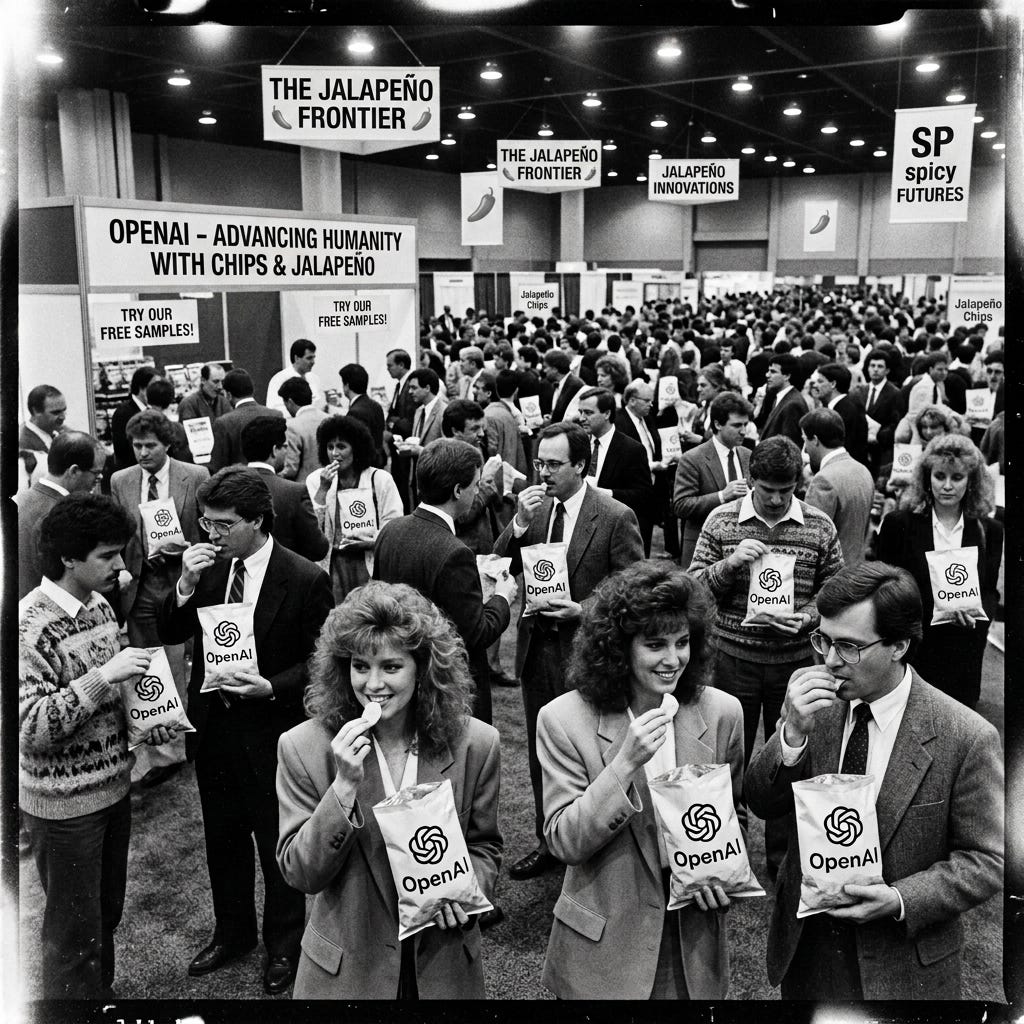
The story: On August 25 at Hot Chips, a chip industry conference held at Stanford, OpenAI presented Jalapeño (but seriously, Jalapeño chip?? I make the jokes around here, Sam). It is an ASIC, which is a chip built to do one job well and nothing else, and its one job is inference (or, the model answering your questions, which happens after all the training is finished). OpenAI built it with Broadcom, and the first published benchmarks put it ahead of Nvidia’s current rack systems on efficiency.
What happened:
OpenAI presented Jalapeño at Hot Chips on August 25, its first custom chip, co-developed with Broadcom
Jalapeño is rated at 700 watts against 1,200 for Nvidia’s GB200 and 1,400 for the GB300, and measured power stayed at or below 550 watts during testing
The published claims are 1.5x to 1.9x more throughput per kilowatt and 1.7x to 3.6x lower end-to-end latency than those Nvidia systems
SemiAnalysis ran the benchmarks alongside OpenAI engineers in OpenAI’s own lab, on single-token prediction, while Nvidia deployments commonly run multi-token prediction in production
Jalapeño was never tested against Vera Rubin, the Nvidia platform slated to power the first gigawatt-scale systems, and OpenAI plans to deploy the chip in its own data centers later in 2026
OpenAI buys a metric gripload (i.e. a LOT) of Nvidia hardware, and every chip it builds itself is a chip it doesn’t have to buy. For now, though, it will keep buying plenty of them, but it now walks into the next price negotiation with a number of its own. A flattering benchmark makes that number stronger, but there is a good ol' caveat: OpenAI's engineers ran the tests in OpenAI's lab under conditions OpenAI chose (sounds totally fair), and nobody has put Jalapeño up against Nvidia's next platform yet.
ChatGPT has a teen version, goes “how do you do, fellow kids?”
The story: On August 18, OpenAI launched ChatGPT for Teens, a version of the product built for 13- to 17-year-olds. Definitely gives “obviously old cop going undercover as cool teen” vibes. It leads with Study Mode, tighter content limits by default, and a set of controls parents can switch on. The launch arrives after a run of lawsuits over how minors have used the regular version.
What happened:
OpenAI launched ChatGPT for Teens on August 18, aimed at ages 13 to 17
Study Mode responds with guiding questions and step-by-step support, holding back the finished answer
Homework reminders appear when a teen looks like they are copying, and steer them back toward Study Mode
Parents can turn Study Mode on by default, set Quiet Hours, and receive safety notifications
The launch follows a stack of lawsuits, including a Florida suit against OpenAI and cases brought by families after teen deaths, and ChatGPT passed 900 million weekly users in February 2026
Teenagers have been using ChatGPT since it launched, and this is the first version built with them in mind. The protections are real and it’s fair to ask what took them so long. For any parent reading this, the controls exist and you can switch them on today. The open question is age verification, because OpenAI did not detail how it confirms that a 15-year-old is 15.
Google bought a done-zo airline’s inbox for $10 million

The story: Spirit Airlines quite literally stopped flying on May 2, 2026, and everything it owned went into bankruptcy proceedings, including its data. In a wild turn of events, Google (of all companies) won the auction(!) for that data with a $10 million bid. The trove is the internal exhaust of a working airline: employee email, chat logs, service calls, operations records (I imagine the complaint emails to be a comedy goldmine). A federal judge still has to sign off.
What happened:
Spirit Airlines ceased operations on May 2, 2026, and its data went to auction as part of the bankruptcy
Google’s winning bid was $10 million, and Mercor, a company that supplies AI training data, was the underbidder at $7.5 million
The trove includes roughly 100 million emails, 500 million Microsoft Teams items, 17 million OneDrive files and 20.5 million SharePoint items
It also carries more than 30 million recorded customer service calls, over 15 million service chat records, 763,000 flight operation records and 1.2 million fuel slips
Court filings say the data was deidentified before sale and that Google agreed to scrub any personal information it finds, and passenger profiles and frequent flyer records were excluded
Frontier labs (not to be confused with Frontier Airlines) have read most of the public internet already, but what they haven't read much of is the private record of how real organizations actually operate. That’s what we have, right here. Nobody wrote those emails and service calls expecting anyone to read them again, yet here they are, being the most valuable pieces of “business as usual.” Google paid $10 million for that particular 411, and a bankruptcy court just set a public price for all that sweet info.
What I’m watching
Whether the Hugging Face deal actually gets signed, and what the open-source community does if a chip company ends up owning the hub
What METR and Redwood Research put in their own reports on the July incident that OpenAI left out of its write-up
Where Jalapeño lands once it is running in OpenAI’s data centers, and whether anyone benchmarks it against Vera Rubin
Whether other bankrupt companies’ records start hitting auction now that a court has put a public price on the idea
Whether Nvidia’s spending on its own customers starts drawing questions from analysts or regulators


Thanks so much for reading this edition of The Weekly Think.
See you next week, fellow thinkers!