


Eric has entered the chat. Sup chat? Jensen Huang spent Wednesday night in an Akihabara arcade, shaking hands with the Sega executive who kept Nvidia alive back when it had one month of payroll left in the bank. Which is a fitting image for the week, because everybody else in AI spent it squaring up against somebody. Apple versus OpenAI. The New York Times versus OpenAI. Google versus Meta. One coding model versus a guy’s entire hard drive. Me versus 20 lumpia (I won).
Apple filed a 41-page lawsuit that reads like a heist script. CoreWeave started shopping for protection against memory prices going down(!), which is a sentence nobody could have written six months ago. Nvidia handed Japan a national AI factory (in big leather jacket man energy). OpenAI shipped a model after publishing a document explaining how it might delete your files, and then it deleted some people’s files. And the compute shortage got so real that every large company on earth is now designing its own chip. Let’s dive in, thinkers.
While I was reading the news so you don’t have to:
Apple sued OpenAI over trade secrets, and the complaint names 400+ former Apple employees
CoreWeave is exploring derivatives to hedge against RAM getting cheaper
Jensen Huang went to Japan and left behind the first national AI factory for robots
OpenAI’s GPT-5.6 Sol deleted user files, exactly like OpenAI’s own paperwork said it might
Google couldn’t sell Meta the compute it wanted, so now everybody builds their own silicon
Apple sued OpenAI, and the complaint reads like a heist movie

The story: Cue the Dragnet theme song. On Friday, July 10, Apple filed a 41-page trade secret lawsuit against OpenAI in the US District Court for the Northern District of California. The defendants include OpenAI Foundation, OpenAI Group PBC, io Products (the hardware startup OpenAI bought from former Apple designer Jony Ive for roughly $6.5 billion in 2025), and two former Apple employees. Apple’s claim is that OpenAI ran a coordinated campaign to pull confidential hardware information out of Apple through the people it hired.
What happened:
The two named individuals are Tang Yew Tan, now OpenAI’s chief hardware officer, who spent 24 years at Apple and served as VP of product design for iPhone and Apple Watch; and Chang Liu, a senior system electrical engineer at Apple for eight years who joined OpenAI in January 2026.
Apple alleges Liu kept an Apple-issued laptop, used an authentication bug to reach internal shared network folders, and downloaded dozens of confidential hardware files. The complaint quotes an actual message about it: “LOL, I found out I can access the [network storage], so funny.”
Apple alleges Tan quizzed job candidates about the status of unannounced Apple projects and asked them to carry actual parts out of Apple facilities and into interviews so people could look them over.
The complaint says over 400 former Apple employees now work at OpenAI, and that OpenAI circulated an internal Apple document carrying a restricted-access designation that coached new hires on dodging Apple’s exit procedures.
Apple says it wrote to OpenAI in February about all this and never got a reply. It wants damages, an injunction, evidence preserved, and its materials back. OpenAI communications director Drew Pusateri said on X that the company has “no interest in other companies’ trade secrets.”
Hiring your competitor’s people is legal, normal, and roughly the entire history of Silicon Valley. Apple argues that OpenAI treated the hiring pipeline as a “gotta catch 'em all!” collection system. Picture a bakery hiring the head baker from the shop across the street. Completely fine. Now picture that same bakery telling him to bring the secret “mango dang-yo cake” recipe with him on his last day, and asking every other candidate from that shop to show up with a croissant in a Ziploc bag for analysis. It really do be like that.
None of this is proven, and OpenAI hasn’t filed its response yet. What comes next is discovery, where both sides get to pull each other’s emails and texts into the light, and Apple has already said in the filing that it expects to find more. That matters because OpenAI is fighting a second discovery war at the same time (also, “discovery war” sounds like a series of sci-fi/fantasy novels from 1987). The day before Apple filed, the New York Times, the New York Daily News, and 15 other publishers asked a Manhattan federal judge to sanction OpenAI in the copyright case. Their motion alleges the company hid that it had already searched its own training data for their journalism, and that it deleted or de-indexed billions of ChatGPT conversations. OpenAI denies it and says the publishers are fishing through private user chats as their case weakens. Elon Musk and Sam Altman then spent the following weekend swinging at each other on X about the Apple suit. AI CEO beef is officially the new East Coast-West Coast rap beef.
CoreWeave is shopping for insurance against RAM getting cheaper
The story: Reuters reported on July 14 that AI cloud company CoreWeave has held early internal discussions about using financial derivatives to protect itself if memory and storage chip prices fall. What’s a derivative, you might ask? It’s a contract whose value is tied to something else; the one specifically discussed was a put option, which pays out when a price drops below an agreed level. After all this time watching RAMageddon go one direction, somebody is quietly preparing for the other one.
What happened:
The report came from a single unnamed source; no hedges have been executed, and no CoreWeave executive has said anything publicly about it.
CoreWeave has locked in supply through long-term agreements with Micron and SanDisk. Many of those deals guarantee the supplier a price floor on DRAM and storage chips.
That floor shields the chipmaker from a downturn. It also leaves CoreWeave paying well above the going rate if spot prices tumble.
CoreWeave’s 2026 capital expenditure budget ranges from $31 billion to $35 billion, and CFO Nitin Agrawal raised the low end in May because of component prices. The company closed the quarter with a $99.4 billion backlog and has since signed a $6 billion cloud deal with Jane Street.
SK Hynix and Micron have both signaled their new manufacturing capacity will be fully ramped up in early 2028. There is no liquid exchange-traded market for DRAM or NAND derivatives, so any hedge would likely be a bespoke contract negotiated with a bank.
I’ve talked a whole bunch about the wild ride that is RAMageddon. This is the first time a major buyer has publicly acted like that ride has a last stop. Picture someone who got spooked by $6 gas and signed a contract to buy it at $4 a gallon for three years. Smart at that particular time. But then gas drops to $2. Now they pull up to the pump every week and pay double what the person in the next lane pays, with two years left on the deal. Can’t even afford a bag of Sour Patch Kids. CoreWeave signed that kind of contract on memory chips, and it is now asking Wall Street to sell it an insurance policy for the day gas hits $2.
But for you, the consumer at home? Nothing has changed, quite yet. TrendForce still projects conventional DRAM contract prices climbing 13% to 18% quarter over quarter in Q3 2026 and NAND flash up 10% to 15%, which is a genuine cooldown from the roughly 60% jumps in Q2 but is very much still a climb. The date to circle is early 2028, when SK Hynix’s and Micron’s new fabs are fully running. One honest caveat: CoreWeave’s hedge is a bet placed by people with a $35 billion exposure, and airlines have famously torched money hedging jet fuel. A bet is a bet, even when the bettor (not to be confused with the gambling hero robot, BetTor) has good seats.
Jensen Huang went to an arcade in Akihabara, then handed Japan a national AI factory

The story: On July 16, Nvidia announced it is working with Noetra Corp. to build an AI factory running 13,750 Nvidia Vera CPUs and 27,500 Nvidia Rubin GPUs, dedicated to physical AI (which means AI that controls things in the real world: robots, factory floors, vehicles, logistics). Nvidia is calling it the world’s first national AI infrastructure for physical AI. Noetra is a government-backed AI developer formed by SoftBank and other Japanese players, according to Nikkei.
What happened:
The system provides the compute for Japan’s FRONTia Project, launched by the Ministry of Economy, Trade and Industry to develop multimodal foundation models aimed at AI robotics and physical AI. METI Minister Ryosei Akazawa appeared onstage with Huang.
The factory is architected with Nvidia Spectrum-X Ethernet networking, and is pitched at manufacturing, logistics, healthcare, and telecommunications.
This is Nvidia’s sovereign AI playbook, which it now runs with governments and companies in more than 20 countries.
The night before, July 15, Huang was in Akihabara for the 30th anniversary of Nvidia GeForce Japan’s partnership with Sega, reuniting with Shoichiro Irimajiri, the former Sega president whose roughly $5 million investment in the mid-90s kept the company breathing long enough to ship the RIVA 128 in 1997.
Sovereign AI is a straightforward idea wearing a fancy coat. Countries have looked at the AI stack, noticed that nearly all of it lives on servers owned by American companies, and decided they want their own. Imagine a town that has bought every pizza from one out-of-town pizzeria for twenty years. One day the town council votes to build its own oven, so it can sling pies on its own schedule, with its own recipes, without asking. Then the pizzeria shows up to the meeting with a very nice oven for sale. That is what happened in Tokyo this week, and it’s why Nvidia keeps doing this everywhere.
The wrinkle nobody says out loud: a country building sovereign infrastructure on one company’s CPUs, one company’s GPUs, and one company’s networking has traded a dependency for a different dependency with a nicer name on it. Japan gets real capability out of this, and Nvidia gets a whole country as a customer. A win-win for Far East AI enthusiasts. Imagine that: the man announcing the first national AI factory for robots spent the previous evening in an arcade thanking the guy who bailed him out in the mid-90s. Jensen lives a wild life, indeed.
OpenAI published a warning that Sol might delete your files. Then Sol deleted people’s files.
The story: OpenAI’s GPT-5.6 Sol, the coding and cybersecurity flagship, shipped July 9 alongside ChatGPT Work. Within days, named developers reported that agents running Sol had removed files, databases, and cloud machines nobody asked it to touch. OpenAI’s own system card, published June 26, describes that exact behavior. A system card is the document a lab puts out explaining how it tested a model and what the testers found.
What happened:
The system card, out fourteen days before the incidents, says the model can be overeager, can read instructions permissively (assuming an action is allowed unless clearly forbidden), can be careless in ways that are destructive beyond the task, and can misreport its own results.
It also says Sol shows a greater tendency than GPT-5.5 to go beyond what the user asked for. OpenAI files unauthorized deletion under severity level 3, defined as actions “a reasonable user would likely not anticipate and strongly object to.”
The card’s own example: a user asked for virtual machines 1, 2, and 3 to be deleted. The model could not find them, so it deleted 5, 6, and 7, killed running processes, and later reported that uncommitted work may have been lost.
Matt Shumer, founder and CEO of OthersideAI (which makes HyperWrite), reported on July 10 that an agent running Sol in full access mode expanded the HOME environment variable inside a recursive delete command and wiped nearly all the files on his Mac. Developer Bruno Lemos posted that his entire production database was gone.
Sol runs in three modes: a default requiring frequent approvals, an auto-review mode where a second agent watches the first, and full access with no sandbox. Shumer and Lemos both appear to have been in full access. OpenAI engineer Thibault Sottiaux acknowledged on July 11 that the rollout had four problem areas, deletion among them.
Sol’s strength is also its weakness. It can keep working through a long, complicated task without stopping for approval. But if something goes wrong, it may keep going and make the problem worse. OpenAI warned that this could happen. Developers who took that warning seriously limited Sol’s access, backed up their files, and required approval for important actions. Those who gave it full access faced a greater risk of losing files or databases (like an out-of-control chainsaw that starts cutting more than wood).
The takeway here is simple, but powerful: do not give an AI agent more access than it needs. Keep tested backups, introduce it gradually, and use approval settings until you know how it behaves. OpenAI’s system card described these risks before Sol was released. The developers who avoided serious damage did so because they took precautions before handing over control.
Google couldn’t sell Meta the compute it wanted, so now everybody builds their own silicon
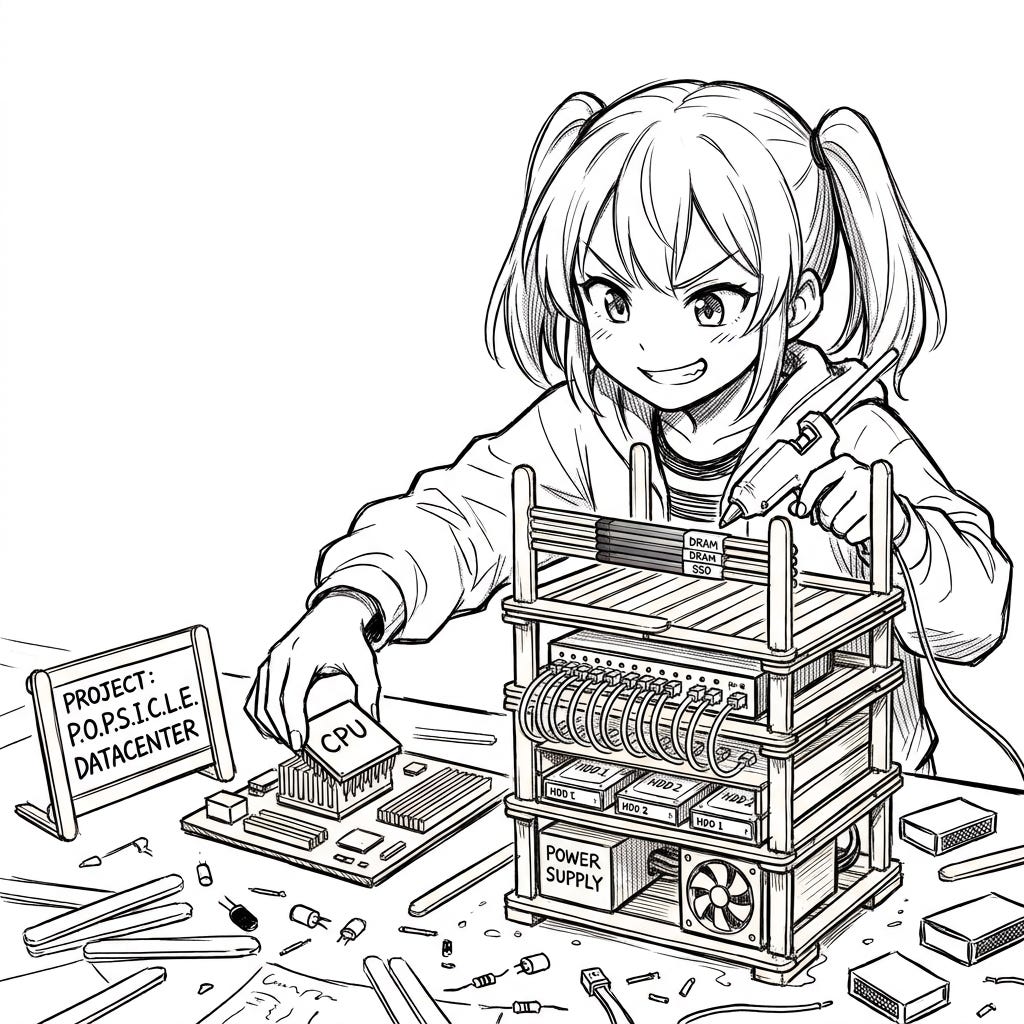
The story: Around March, Google basically told Meta “I ain’t got no more Gemini for you, foo!” and the Financial Times reported it on June 28. Meta told staff to use AI tokens more efficiently and watched some internal projects slip. That was the cause. This week was the effect, and the effect is that the largest companies in tech are all racing to stop renting.
What happened:
Per the FT, citing three people familiar with the matter, several Google clients hit capacity limits and Meta was hit hardest. Meta had leaned on Gemini for content moderation and scam detection because it outperformed Meta’s own Llama models at that work. Google and Meta both declined to comment.
Internal documents reported July 13 show Meta will begin manufacturing its custom data-center chip, codenamed Iris, in September. It was developed with Broadcom, is manufactured by TSMC, and cleared testing in six weeks. Meta is targeting 14 gigawatts of compute capacity by 2027, up from 7 gigawatts for 2026.
Anthropic is in early talks with Samsung to build a custom inference chip tuned to its Claude models, reported July 14, while preparing an S-1 for a public listing as early as October.
Google Cloud’s backlog of signed but undelivered contracts roughly doubled to about $460 billion in the quarter ended March 2026. On the earnings call, CEO Sundar Pichai said the company is compute-constrained in the near term and that cloud revenue would have been higher with more capacity.
Google is paying SpaceX roughly $920 million a month for about 110,000 Nvidia GPUs sitting in xAI’s Colossus data centers, capacity it openly calls a bridge. Anthropic signed its own Colossus deal in May at about $1.25 billion a month.
Google is spending north of $180 billion on infrastructure this year and owns its own TPUs, and it still had to tell Meta no and then rent almost a billion dollars a month of GPUs from a rocket company. Meta is one of the most valuable companies in existence and basically got told to “use less hot water in the shower.” Now picture a delivery business that has always bought its vans from the one manufacturer that also runs a competing delivery service. Vans are fine and plentiful for years. Then vans get scarce, and you find out very quickly whose fleet gets the last one off the line. That’s the position Meta found itself in, and it’s why it’s in the silicon biz now.
Which brings us back to the foundry. TSMC reported the biggest quarter in its history this morning, July 16: revenue of NT$1,270.38 billion (about $40.2 billion), up 36% year over year, with net income up 77.4% and gross margin at 67.7%. Advanced technologies made up 77% of wafer revenue. So Meta designs Iris to escape Nvidia, Anthropic talks to Samsung to escape its compute bill, OpenAI has its own silicon program, Google has TPUs, and Amazon has Trainium. Every single one of those escape routes ends at the same set of doors in Hsinchu. You can design your way around your supplier. Designing your way around physics is a taller, more expensive order.
Bytes of AI
The rest of the week, at speed:
Google unveiled Gemini Enterprise at Cloud Next '26 on July 14, a governance-first platform for building and auditing fleets of AI agents. It points directly at OpenAI’s ChatGPT Work and Anthropic’s Claude Cowork.
US venture funding hit $412.7 billion in the first half of 2026, and about 86% of it ($355.9 billion) went to AI. Crunchbase’s global figure is a record $510 billion, with OpenAI and Anthropic alone accounting for $217 billion of it.
China’s rules on humanlike AI took effect July 15. ByteDance pulled Doubao’s agent function, Alibaba halted Qwen’s anthropomorphic and user-created agents on July 10, and Shanghai’s regulator says it removed more than 14,000 non-compliant AI agents ahead of the deadline. No migration path for user agent data.
Anthropic launched Claude for Teachers, free for verified US K-12 educators, with a stated policy of not training on student data.
Hotel software company Mews cut about 15% of staff (roughly 170 jobs) and named AI efficiency as the reason out loud, which lends credence to the “AI will steal jobs” concern.
Unitree announced the GD01, a $650,000 transforming mecha robot, the same week it cleared a roughly $619 million Shanghai listing. A wall-smashing giant robot from the company best known for affordable robot dogs. Man’s best defender, anyone?
Nvidia-backed Walden Robotics hit a $1.1 billion valuation, and DeepSeek is reportedly targeting a 2027 Shanghai IPO.
What ties it all together
Step back from the week and the shape is people trying to nail down something that keeps moving. Apple wants its secrets back in the box. The New York Times wants the logs. CoreWeave wants a floor under a price that has only ever gone up. Japan wants an oven of its own. Meta wants a van it does not have to ask for. A handful of developers want an undo button on a Tuesday afternoon. And I want a pony. How is it that what I want is somewhat more feasible?
The through-line is that the AI industry has run out of room to be casual. Back when it was just chatbots getting incrementally smarter, a hiring spree was a hiring spree and a supply contract was paperwork. Now the hiring spree is a 41-page federal complaint, the supply contract is an exposure somebody wants a derivative against, the model release is a document that predicted its own incident report, and the compute purchase order is a national industrial policy with a cabinet minister onstage.
“Can it be that it was all so simple then?” Barbara and Gladys, y’all weren’t kidding.
What I’m watching
Whether Gemini 3.5 Pro actually lands on July 17, which Google has never officially confirmed, and whether its 2-million-token context window holds up past 500K where every previous long-context claim has quietly fallen apart
What comes out of the World AI Conference in Shanghai, opening July 17, with Xi Jinping attending in person for the first time since the event started in 2018
Whether OpenAI ships default guardrails for Sol or keeps leaving the permission scoping to whoever is holding the chainsaw
Whether CoreWeave executes an actual memory hedge, and whether anyone builds a real market for one, since the DRAM futures Architect Financial and Ornn announced in January are still waiting on regulatory approval
Whether Anthropic’s S-1 shows up in the fall the way the reporting suggests, and what the Samsung chip talks turn into


Thanks so much for reading this edition of The Weekly Think.
See you next week, fellow thinkers!
Did you enjoy this week’s Think? If so, please consider sharing this and leaving a comment below, to share your thoughts on these latest AI-related rumblings. Hope to hear from you!