

Eric’s back, back again. Eric’s back, tell your friends! I was away last week, figuring the AI world would do its usual thing and crank out a few model updates I could catch up on later. Friends, it didn’t do its usual thing. I come back to find that Elon Musk’s rocket company is now one of the biggest companies on the stock market, it spent $60 billion on a coding tool like it was grabbing an impulse buy at checkout, Apple changed CEOs, and the heads of the major AI labs got seated at a table with world leaders. Good gravy.
Before we get into this week’s big stuff, let me catch us both up on the June 4-10 stretch I missed, because a lot of it matters for what came next.
While I was gone (the June 4-10 bytes):
Apple said goodbye to Tim Cook. At WWDC on June 8, Apple unveiled a rebuilt, Gemini-powered Siri (Google on an iPhone? Eric Schmidt would never), and made Claude a selectable option too. The keynote was Cook’s last as CEO before he hands the reins to hardware chief John Ternus on September 1.
OpenAI filed to go public too. On June 8, OpenAI confidentially filed its own paperwork with the government, joining Anthropic and SpaceX in the IPO line. Their announcement basically said “we figured this would leak, so here you go.”
ChatGPT dropped below 50% market share for the first time. Per a Sensor Tower report, ChatGPT now sits under half the market, with Google’s Gemini at 27.7% and Anthropic’s Claude at 10.3%. The two-horse race became a three-horse race while I was drinking a cold brew.
Snap announced $2,195 AR glasses. Called Specs, with OpenAI and Gemini built in, aiming to beat Meta’s comparable glasses to store shelves. Two thousand dollars for face computers. We live in the future, and the future demands a home equity line of credit.
Okay. Caught up? Cool! Let’s get into the stuff that happened this week.
SpaceX went public and became the fourth most valuable company in America

The story: On June 12, Elon Musk’s SpaceX (which now includes his AI company xAI, maker of the Grok chatbot) sold shares to the public for the first time. It raised about $75 billion, the biggest stock-market debut in history, and the stock jumped 19% on day one. That pushed the company’s total value above $2 trillion and, after a few more days of climbing (like a crazed mountain man), made it the fourth most valuable company in the United States.
What happened:
SpaceX priced its shares at $135 and they closed the first day near $161, then kept climbing through the following week.
The $75 billion raised beat every prior IPO on record. For scale, that’s roughly the entire yearly budget of NASA, raised in a single morning.
The company is not profitable. It lost close to $5 billion in 2025, and several analysts flat-out called the valuation too high (one slapped a “sell” rating on it the same day).
Alphabet, Google’s parent, quietly owns about 4.9% of SpaceX, a stake now worth around $105 billion.
This is the first of three giant AI-related IPOs lined up back-to-back, with Anthropic and OpenAI both having filed their own paperwork in the past two weeks.
A few editions back I wrote about Anthropic, OpenAI, and SpaceX all heading for the stock market at the same time, and how the public was about to get its first real read on whether the AI hype holds up. Well, SpaceX went first, and the read was “investors are very, very interested.” Regular peeps piled in at record numbers. Whether that enthusiasm is wisdom or mania is the question, and the analysts arguing the company is overvalued might be right. Either way, the first domino (tile, not the pizza) fell, and it fell loudly (like me, after eating too much Domino’s… the pizza, I mean).
The part of this that really stands out is who got rich. More than 4,400 current and former SpaceX employees are expected to become millionaires from the IPO, and a lot of them never wrote a line of code or designed a rocket (meanwhile, I invented the MP3 player but… oh forget it). We’re talking welders, machinists, technicians, even cafeteria workers, people who got company stock as part of their pay. One former welder, Juan Hernandez, joined in 2015 at $28 an hour, barely knowing what SpaceX was. His roughly 6,500 shares were worth just over a million dollars(!) when the stock closed on day one, and he’s now teaching his kids how to invest.
Then, four days later, SpaceX bought Cursor for $60 billion
The story: On June 16, fresh off the record IPO, SpaceX announced it’s buying Anysphere, the company behind the popular AI coding tool Cursor, for $60 billion in stock. Cursor is a program developers use to write software with an AI assistant doing a lot of the typing (like a guy with a typewriter following around a smart dude). The deal makes it the most expensive AI software purchase ever announced, and it happened four days after the company went public. In four days, I’m usually wondering if the leftover chicken in the fridge is still okay to eat.
What happened:
The deal is all-stock, meaning SpaceX is paying with its own newly public shares, no cash required, which it can afford to do precisely because those shares are valued so high.
Cursor brings in roughly $2.6 billion a year and had been talking to investors about a $50 billion valuation just two months earlier.
This folds Cursor into xAI, Musk’s AI arm, giving it a direct foothold in coding tools to compete with Anthropic’s Claude Code and OpenAI’s Codex.
The purchase represents only about 3.4% of SpaceX’s value, which tells you how much a sky-high stock price lets you throw around.
It briefly pushed SpaceX past Microsoft in total value during Tuesday trading.
Here’s the big, notable thing here. The major AI coding tools have nearly all been swallowed by giants in a remarkably short time (like CEOs swallowing a Limitless pill). Microsoft owns GitHub Copilot. Anthropic has Claude Code. OpenAI has Codex. And now SpaceX has both Grok’s coding tools and Cursor. A year ago these were scrappy independent startups devs loved. Now almost all of them answer to one of a handful of enormous parent companies.
If you’re a dev, this affects which tools stay independent and which start nudging you toward their parent company’s ecosystem. The thing to do is keep your own skills portable. Learn the underlying craft itself, deeper than any one tool’s buttons, so that when the tool you rely on gets bought and changed, you can move without starting over. Ownership shuffles at the top; your ability to actually build is what stays yours.
Apple swapped CEOs and put Google’s AI inside the iPhone
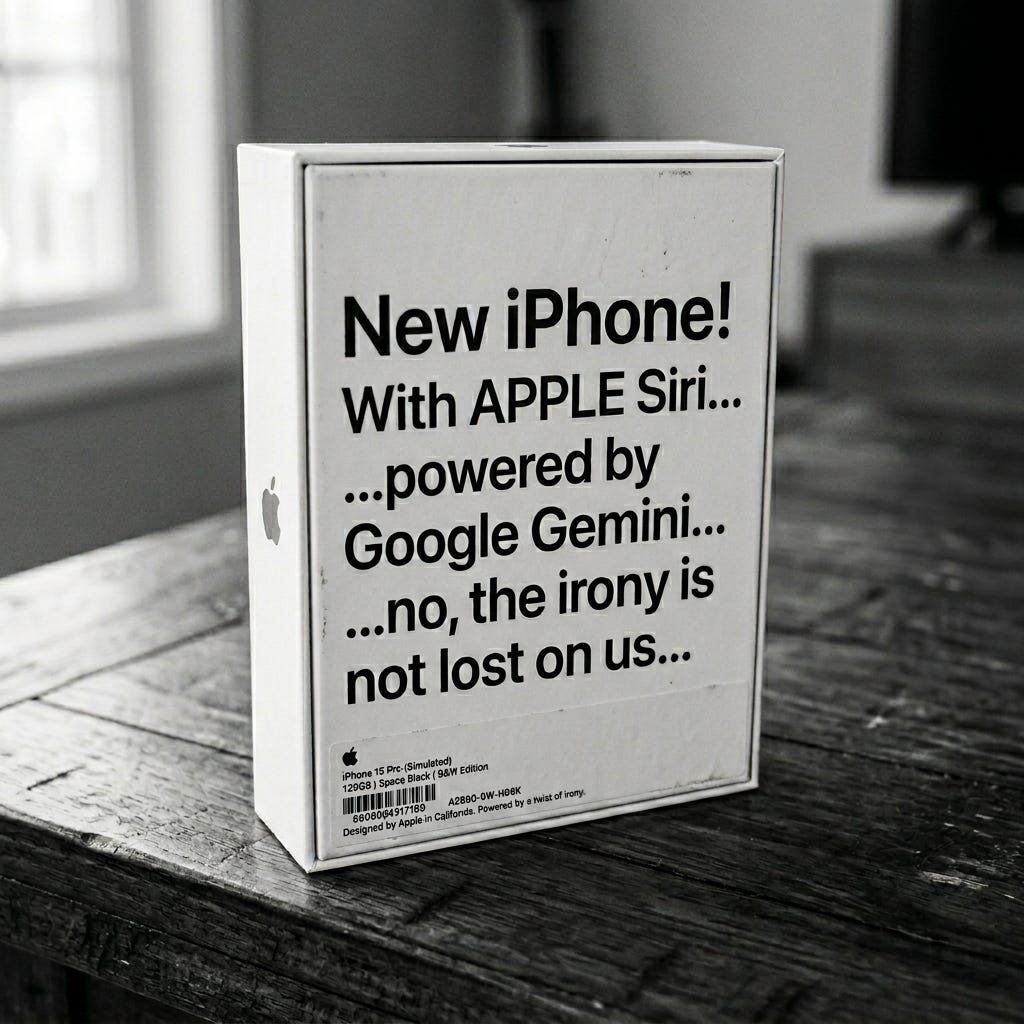
The story: This one technically kicked off during my time away, on June 8, but your boy needs to expand on this. At its developer conference, Apple unveiled a completely rebuilt Siri running partly on a custom version of Google’s Gemini AI, and it was Tim Cook’s final keynote as CEO. He steps down September 1 after about 14 years, handing the company to hardware chief John Ternus.
What happened:
The new Siri uses a three-tier system: simple stuff runs on your phone, medium stuff on Apple’s private servers, and the heaviest thinking routes to a 1.2-trillion-parameter Google Gemini model running on Nvidia chips in Google’s cloud.
Apple says it anonymizes every query so neither Apple nor Google can tie a request back to you.
Special guest star, Claude: Apple made multiple AI assistants selectable, so Anthropic’s Claude can be an iPhone option for the first time.
Apple also previewed homeOS, the software for a long-rumored smart-home gadget (a HomePod with a screen) expected this fall.
The Siri rebuild arrives after a $250 million settlement with iPhone buyers who said Apple advertised Siri features back in 2024 that never actually shipped.
The interesting thread here is what it means that Apple, the company famous for building everything itself, decided the fastest way to fix Siri was to put a competitor’s AI underneath it. For two years Apple promised a smarter Siri and kept missing. So it partnered with Google, a company it competes with on phones, search, and maps. Swallowing that much pride tells you how hard building a frontier AI model has become even for the richest company on earth. Somewhere, Eric Schmidt is laughing maniacally.
For the rest of us, this means the AI you use every day is about to show up in places you didn’t install it. If you own an iPhone, Google’s Gemini and possibly Anthropic’s Claude are coming to your home screen this fall whether you sought them out or not. Knowing what’s under the hood, and what each one does with your questions, is becoming basic digital hygiene.
AI wrote so much code it knocked GitHub offline
The story: In a very Obi Wan “you have done that yourself” sorta way, GitHub, the website where the world’s programmers store and share their code (owned by Microsoft), got so overwhelmed by AI coding agents pumping out work that its reliability cratered. On June 16, Microsoft confirmed it’s temporarily borrowing computing power from Amazon, its direct cloud rival, just to keep GitHub running.
What happened:
GitHub was processing about 275 million code submissions per week, on pace for 14 billion in 2026, up from 1 billion in all of 2025.
Automated pull requests (changes opened by AI agents) jumped from 4 million last September to over 17 million by March.
The site logged nine separate service problems in May, and its uptime in June fell to about 88.4%, well under the 99.9% it promises business customers.
To cope, Microsoft is routing some GitHub traffic through Amazon Web Services while it finishes moving the platform onto its own Azure cloud by 2027.
This is part of a broader crunch: Google reportedly pays SpaceX $920 million a month for computing power, and Anthropic pays SpaceX $1.25 billion a month for its Colossus supercomputer.
The plain version of what happened: AI code writing is all the hype and it generated more work than the internet’s main code warehouse could physically handle. The humans pointed the tools at their projects, the tools produced an avalanche, and the warehouse buckled. It’s a little like all the kids in the neighborhood absolutely overwhelming the ice cream truck on the hottest day of the summer. The demand is real, the tools are doing what they were asked, and the physical infrastructure underneath is scrambling to keep pace.
The lesson that keeps repeating across these editions is that compute and infrastructure are the real bottleneck now. The thinking ability of the models stopped being the hard part a while ago; the hard part is having enough machines and electricity to run them. Even Microsoft, a company that owns one of the three biggest clouds on the planet, had to call up its archrival Amazon for backup. If you’re building anything on top of these tools, plan for the plumbing to creak. The smart projects right now are the ones designed to work even when the service they depend on is having a rough day. Locally-run AI, anyone?
The government switched off Anthropic’s newest model three days after launch

The story: On June 12, the US Commerce Department ordered Anthropic to cut off access to its two newest, most capable models, Fable 5 and Mythos 5, citing national security. The order specifically barred any foreign national from using them, including Anthropic’s own foreign-born employees. Since Anthropic can’t be all TSA and check the passport of every person sending a request in real time, it did the only thing it could and shut both models off for everyone. The kicker: the models had launched just three days earlier, on June 9. Imagine throwing a party, and the city condemns your house before the guests finish their charcuterie.
What happened:
The directive landed at 5:21 p.m. ET on a Friday, in a letter from Commerce Secretary Howard Lutnick to Anthropic CEO Dario Amodei, and the letter reportedly gave no specifics about the actual concern.
Anthropic says that the trigger was a “jailbreak,” a trick that gets a model to do something its safeguards block. The specific one, by Anthropic’s account, amounted to asking the model to read a codebase and point out its security flaws.
Anthropic says that same capability is widely available from other models that weren’t banned, naming OpenAI’s GPT-5.5 directly (like a kid saying “but mom, Tommy broke the window too!”)
Every other Anthropic model, including its flagship Opus 4.8, stayed online and unaffected. The takedown hit only the two newest releases.
This appears to be the first time the US government has forced a publicly deployed frontier AI model offline. Imagine if Microsoft said “turn off the Word, boys.”
The absurd bit, and the reason this story is more interesting than scary, is the mismatch between the hammer and the nail. A government used national-security export powers, the kind of tool aimed at missile guidance systems and nuclear materials, to pull a chatbot over a bug-finding trick that a half-dozen other chatbots can also do. Anthropic basically said as much in its response, arguing that if this became the standard, every frontier model from every company would have to be yanked too. Whatever you think of Anthropic, them dudes have a point.
The reason this matters for everyone, not just Anthropic’s customers, is the precedent. A switch now exists, and a government just proved it’s willing to flip it. That has nothing to do with whether you like Anthropic or trust the government’s call here. It’s a structural fact about how AI works now: the model you build your business on can be switched off by an email sent at 5:21 on a Friday. If you’re building on any single AI provider, the practical lesson is to keep a fallback ready, because the hypothetical “the model just vanished” just got really real.
What ties it all together
I was gone two weeks. In that time the biggest IPO in history happened, the company behind it immediately spent $60 billion on a coding tool, the most valuable company on earth changed CEOs and adopted a rival’s AI, the website that holds the world’s code fell over from AI overuse, and the government switched off the newest models from one of the top AI labs. If you’d told me all of that in advance, I’d have asked what possessed you to generate all of that with AI.
Step back and look at the shape of it. The money is going public, the giants are absorbing the startups, the rivals are partnering when pride used to stop them, the infrastructure is straining under its own success, and the government just showed it can switch a model off whenever it decides to. The common thread is consolidation. Power, money, talent, and infrastructure are all flowing toward a smaller and smaller number of very large players, and it’s happening faster than anyone can write newsletters about it. Any reason for alarm here? I’ll let you decide, peeps.
What I’m watching
Whether SpaceX’s stock holds its sky-high value or the “overvalued” analysts get proven right
Whether Anthropic or OpenAI actually pull the trigger on their own IPOs, and how the market receives them
What happens to Cursor’s independent feel now that it answers to Musk
Whether GitHub stabilizes, or the AI-code firehose keeps outrunning the servers
Whether Anthropic gets Fable 5 and Mythos 5 switched back on, and whether the government ever spells out its actual reasoning

Highkey sad that Hall & Oates are enemies now.

Thanks so much for reading this edition of The Weekly Think.
See you next week, fellow thinkers!
Did you enjoy this week’s Think? If so, please consider sharing this and leaving a comment below, to share your thoughts on these latest AI-related rumblings. Hope to hear from you!