

Ahoy, AI news, starboard bound! So, Google I/O came, I/O saw, and I/O dropped a whole lot of Gemini on us. I/O am intrigued (okay, that’s enough of the I/O)! The short version: Google spent the week reminding everyone that the company with two billion users and its own chips (sadly, not Ruffles) is, in fact, still here.
The bigger theme this week ran underneath the product news: people, lawsuits, and money. Anthropic landed one of the most respected researchers alive. Musk’s big swing at OpenAI got tossed by a jury before lunch. And OpenAI quietly turned on the thing everybody claims to hate but secretly keeps the lights on: ads. Let’s get it, y’all.
Here’s what’s covered today:
Google I/O dropped Gemini 3.5, a 24/7 agent named Spark, and smart glasses
Andrej Karpathy left the OpenAI orbit and joined Anthropic
A jury threw out Elon Musk’s lawsuit against OpenAI in under two hours
ChatGPT opened a self-serve ad platform (your chatbot has a billboard now)
Samsung crossed $1 trillion, and the memory crunch is minting winners
And your “oof” moment of the week
Google I/O: Gemini 3.5, a 24/7 agent, and a $100 price cut nobody saw coming
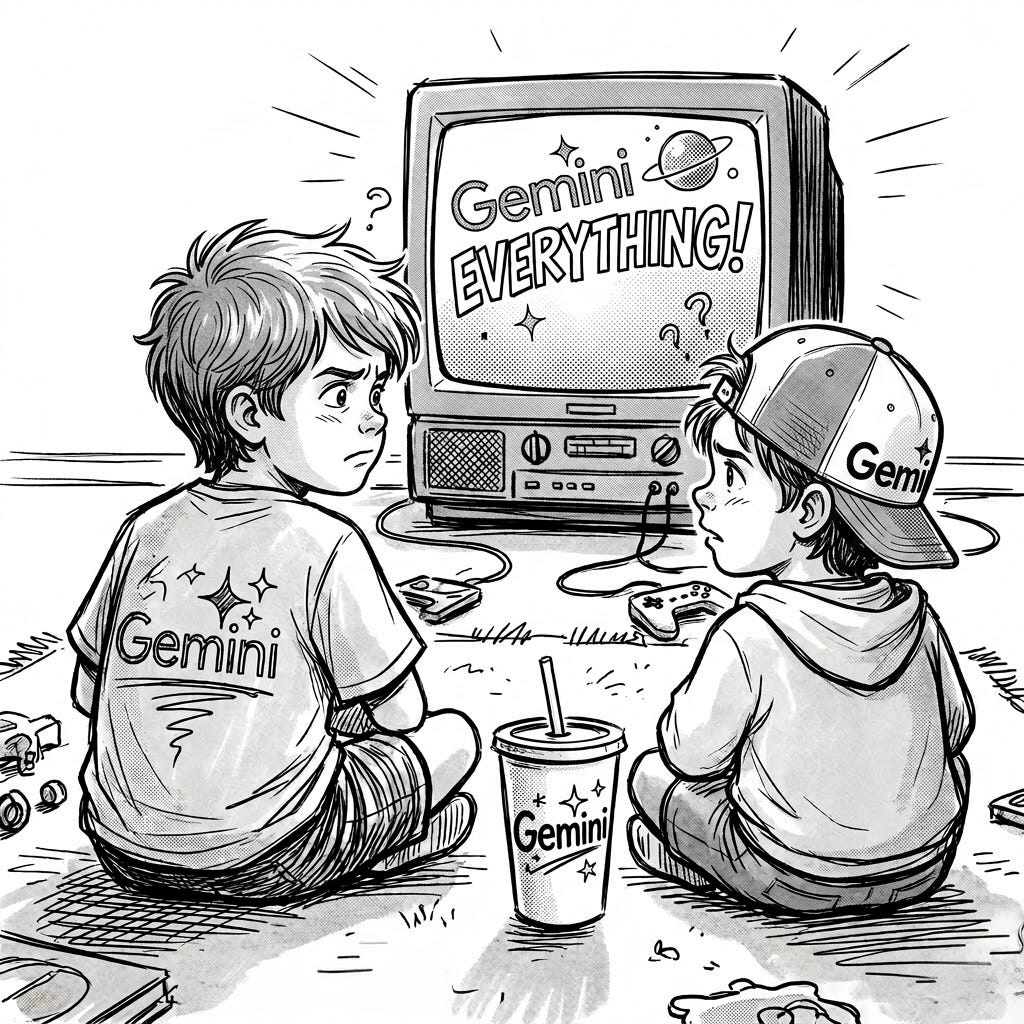
The story: On May 19, Google held its I/O keynote and did what Google does best lately, which is cram Gemini everywhere it can (still waiting on Gemini: The Wholesale Store and $1.25 Polish sausages). The headliners were Gemini 3.5 Flash (available that day), a 24/7 personal agent called Gemini Spark, a new design language called Neural Expressive, and a surprise price drop on its top AI plan.
What happened:
Gemini 3.5 Flash beats the older 3.1 Pro on coding and agentic benchmarks while running 4x faster, and it’s already powering Search.
Gemini Spark is a personal agent that runs on Google’s cloud (so it keeps working even when your laptop is closed) and takes actions across Gmail, Docs, and Calendar.
Google AI Ultra dropped from $250 a month to $100, and the old $250 tier became $200 with the same features. A price cut, in this economy!
The first Android XR “audio glasses” are coming this fall, built with Samsung and Qualcomm, with frames by Warby Parker and Gentle Monster.
The glasses pair with both Android phones AND the iPhone, which is a quiet little flex aimed directly at Apple.
Last week, I wondered whether I/O would land a full Gemini 4 or settle for an incremental bump. The answer was sorta neither. Google shipped a 3.5 (“like 3, but with a .5!”), but the real story was Spark. A model is a tool you pick up and put down. An agent is something that keeps working while you sleep. Your phone running little, tireless virtual contractors; Google just made that the centerpiece.
If you use Google’s stuff all day (fair, in this day and age), keep an eye on Spark when it lands for Ultra subscribers next week. The price cut to $100 tells you Google wants this in as many hands as possible, as fast as possible.
(Hrmm. I feel like I missed an Old MacDonald joke opportunity here. Oh well… E, I, E-I/O! Felt good to get that out of my system.)
Andrej Karpathy left the OpenAI world and joined Anthropic
The story: On May 19, Andrej Karpathy announced he’s joining Anthropic. If that name doesn’t ring a bell, here’s the context: he was a founding member of OpenAI, he ran Tesla’s self-driving AI program, and he’s one of the most respected teachers and researchers in the entire field. People learn how neural networks work from his free YouTube lectures. In the AI world, my mans is considered all that and a bag of chips.
What happened:
Karpathy is starting a team focused on using Claude to speed up its own pre-training research (AI helping build AI; the snake is eating its tail, and it’s thrilled about it).
Pre-training is the giant, wildly expensive phase that gives a model its core smarts.
Anthropic also picked up Chris Rohlf, a 20-year cybersecurity veteran from Meta, for its frontier red team.
This caps a stretch where Anthropic has become a magnet for top talent and acquisitions (it bought developer-tools company Stainless the day before, on May 18).
Here’s why this is more than AI tea. Karpathy could have gone anywhere (or did what Michael Jackson commanded: to be startin’ somethin’ for himself), and he picked the company betting that AI-assisted research, not just raw compute, is how you stay at the frontier. Think of it like a head chef leaving the biggest restaurant in town to go work at the small, indie kitchen down the street. People notice. Other chefs start updating their resumes. Talent follows talent, and right now the talent is pointing at Anthropic.
If you’re early in your own AI learning journey, check out one of Karpathy’s “Zero to Hero” lectures. The guy explains hard things simply, which is exactly how to play this whole AI game.
A jury threw out Musk’s OpenAI lawsuit in under two hours

The story: WELP, the Musk legal saga got its own ending this week (for now, at least). On May 18, a federal jury in Oakland (shout out to the Bay Areaaaaa) took less than two hours to throw out Elon Musk’s lawsuit against OpenAI and Sam Altman. They didn’t even break a sweat.
What happened:
Musk had accused Altman and OpenAI of “stealing a charity” by turning the nonprofit into a for-profit operation.
The jury never reached that question. They ruled Musk simply waited too long to sue (the legal term is “statute of limitations,” which is a fancy way of saying “you snoozed, you lose”).
The verdict was unanimous, and the judge agreed with it.
Musk says he’ll appeal, calling it a “technicality.”
Fun footnote: this same week, the new coding tool Cursor shipped a model partly trained on Musk’s Colossus 2 supercomputer, which is the sequel to the Colossus 1 that Anthropic leased last week. Elon’s compute is everywhere, even when his lawsuits aren’t winning.
Both Altman and Musk are steering their companies toward the money right now, in what could be record-breaking IPOs. Not a great time to be handed messy verdicts. For Altman, the timing is a gift. For Musk, it’s a day he’d probably like to forget.
The wild reality of it all: the biggest fights in AI are increasingly happening in courtrooms and boardrooms, not research labs. It’s Three O'Clock High up in here and everyone’s coming to see Jerry VS Buddy.

ChatGPT now sells ads (aka here’s your report, now how about some juicy Chicken Nuggets?)
The story: On May 21, OpenAI launched a self-serve advertising platform inside ChatGPT, basically an Ads Manager where companies can buy, run, and tune ad campaigns (“because if Google can do everything, so can we!”, said Altman in a press release I just now imagined). OpenAI is reportedly targeting $2.5 billion in ad revenue this year and a frankly bonkers $100 billion a year by 2030.
What happened:
The platform supports both pay-per-view and pay-per-click ads, the same models that built Google and Facebook.
It plugs into the big ad agencies and ad-tech firms (Dentsu, Omnicom, Publicis, WPP, Adobe, and others).
OpenAI swears ads won’t influence ChatGPT’s actual answers, only where ads appear around them.
This pairs with a separate launch on May 15, where ChatGPT added a personal finance dashboard that connects to your bank accounts.
Every free product you’ve ever loved eventually meets the same fork in the road: charge everybody, or sell ads. ChatGPT just said “why not both?” And yeah, it makes sense. Running these models costs a ludicrous amount of money, so somebody has to pay the piper. The interesting question is whether people will tolerate ads inside a tool they treat like a trusted advisor (remember the Claude Super Bowl ads?).
Here’s the practical bit for you: if you market anything, a brand-new ad channel just opened up, and the early movers on a new channel always get the cheap attention before everyone else floods in. Worth a look-a-roo if you rely on search engine ads.
Samsung hit $1 trillion, and the memory crunch is minting winners

The story: Last week I talked about the memory shortage and the doom of rising laptop prices. This week, here’s the flip side of that same, painful coin. On May 21, news broke that the AI memory boom pushed Samsung’s market value past $1 trillion. The same shortage squeezing your wallet is making the chip companies Dr. Evil-levels of wealthy.
What happened:
Samsung crossed the trillion-dollar mark on the back of soaring AI memory demand.
Nvidia is already pushing memory makers toward 16-layer HBM (the ultra-dense, ultra-fast memory that feeds AI chips) for delivery as early as late this year.
Nvidia is also working on something called “GPU-Direct Storage” for its next-gen Vera Rubin chips, plus a newer memory type called HBF (high-bandwidth flash) that offers roughly 10x the capacity of today’s HBM.
Samsung, SK hynix, and Micron are pouring a combined $50+ billion into new memory factories.
Those factories take 18 to 24 months to build, so relief for your wallet is still a 2027-or-later situation.
The shortage isn’t just pain. It’s also the single biggest wealth-creation event in the history of the chip business. The companies that make the picks and shovels (memory makers, packaging firms, the whole supply chain) are printing money. Samsung joining the trillion-dollar club is the loudest possible signal that the AI buildout is real and it’s nowhere near done (much to the chagrin of PC enthusiasts).
For the innovators reading this: the constraint is the opportunity (or more like, the problemtunity). Every dollar that memory eats is a dollar that rewards software which does more with less. Lean models, smart caching, efficient inference. The crunch isn’t going away soon, so the skill of squeezing value out of limited compute is about to be worth a whole lot.
The Weekly Whoops: the guy who wrote a book about AI lying… got caught lying with AI
The story: Steven Rosenbaum published a book this month called The Future of Truth: How AI Reshapes Reality. It’s a serious-minded warning about how AI distorts what’s real. There’s just one teensie-weensie, itsy-bitsy problem. The New York Times found that the book itself is sprinkled with more than half a dozen fake or misattributed quotes, apparently generated by the same kind of AI chatbots the book is warning you about. Yes, really.
What happened:
One fabricated quote was pinned on tech journalist Kara Swisher, who told the Times she “never said that” and that the AI made her “sound like I have a stick up my butt.”
Neuroscientist Lisa Feldman Barrett got quotes attributed to her that she said “don’t appear in the book and they are also wrong,” the kind of thing she “would never say.”
Rosenbaum admitted the book had “a handful of improperly attributed or synthetic quotes” and opened an investigation into his own book (which is a sentence I enjoyed typing).
He disclosed in the acknowledgments that he used ChatGPT and Claude during research and writing.
His defense, more or less, was that if this serves as a warning about the risks of AI-assisted research, well, that’s the whole point of the book. Bold move, calling the fire your house caught a “fire safety demonstration.”
Here’s the actual lesson buried under the irony. AI is a phenomenal research assistant and a confident liar at the same time (kind of like that one intern, that one summer). The tools will hand you a perfectly phrased, perfectly formatted quote that the “source” never said, and it will look exactly as real as the true ones. There’s a name for it: hallucination. The model isn’t trying to deceive you. It’s pattern-matching what a quote should sound like, and sometimes the pattern wins over the facts.
So if you’re using AI to write anything that has your name on it (a report, an article, a book about truth, or even a weekly newsletter with charming humor that I won’t directly name), verify before it ships. Check every quote, every stat, and every citation against the real source. Do the fact-checking with your own two eyes. That should keep you off the wrong kind of New York Times news page.
What ties it all together
Last week was about distribution. This week was about everything that happens once the distribution land-grab is on: the Clone talent war heats up, the lawsuits get settled, the money gets… money-er, and the companies feeding the whole machine cross into rich Uncle Moneybags territory.
Step back and look at the board. Google is racing to put an agent in two billion pockets (I just checked my pockets for a tiny person). Anthropic is collecting the researchers who build the frontier. OpenAI cleared its biggest legal cloud and turned on the ad money. And Samsung crossed a line only a handful of companies in history ever have, purely because the world cannot get enough AI memory.
The thing worth holding onto is how fast all of this is compounding. Models, agents, talent, money, hardware: each one pulls the others forward. A year ago, any single one of these stories would have been the headline of the month. This week, it’s just business as usual, ‘round these here Weekly Think parts.
What I’m watching
Whether Gemini Spark actually works as advertised when it hits Ultra subscribers next week, or whether it’s another impressive demo
Where Karpathy’s pre-training team shows up first in Claude’s capabilities
Whether Musk’s appeal goes anywhere, or whether this is really the end of the saga
How people react to ads showing up inside ChatGPT (tolerance or revolt?)
Whether any other memory maker chases Samsung into the trillion-dollar club this year


Thanks so much for reading this edition of The Weekly Think.
See you next week, matey!