


The boy is back! America might run on Dunkin’, but this past week, AI ran on money. Anthropic filed to go public on Monday, and saying investors are interested would be an understatement. Microsoft offered buyouts to about a quarter of its workforce the same day, and Meta brought its own chip suppliers in as investors for a stock sale worth up to $95 billion. By Wednesday, a report had OpenAI shopping for Google’s chips and the Justice Department asking questions about Nvidia’s purchase of Hugging Face. Man, I guess chatbots are more like cashbots, am I right?
The short version: Anthropic’s S-11 shows $16.3 billion in revenue for the first half of 2026 and a planned Nasdaq listing under the ticker ANT. About 60,000 Microsoft employees can take a voluntary exit offer until early December. Nvidia and AMD committed a combined $4 billion to Meta’s offering. OpenAI reportedly plans to buy Google’s TPUs, and Oracle will offer those chips on its cloud starting in 2027. And the DOJ wants to know whether owning Hugging Face gives Nvidia too much control over how AI models reach developers. Let’s get into it.
Here’s what’s on the menu today:
Anthropic filed its S-1 to list on the Nasdaq as ANT, showing $16.3 billion in first-half revenue and an $80.7 billion net loss driven mostly by a paper charge
Microsoft offered voluntary buyouts to about 60,000 employees, roughly 27% of its workforce
Meta priced $37.5 billion in new stock for its AI buildout, with Nvidia, AMD and Broadcom named as cornerstone investors
OpenAI reportedly plans to buy Google’s TPUs, and Oracle will offer TPUs on its cloud starting in 2027
The DOJ is asking whether Nvidia’s $12.93 billion Hugging Face deal hands it control of a key AI distribution point
Anthropic filed to go public, and the filing shows the bill for its buildout

The story: On October 26, Anthropic filed a Form S-1 with the SEC. It plans to list its Class A stock on the Nasdaq Global Select Market under the ticker ANT. The move is the first public look at Anthropic’s finances. The share count and price range are still blank. That’s a lot of fancy talk for “AI company make bot and want make money”.
What happened:
Anthropic filed publicly on October 26 after submitting a confidential draft in June, with Goldman Sachs and Morgan Stanley named as the banks handling the prospectus
Revenue hit $16.3 billion in the first half of 2026, up from $1.16 billion in the first half of 2025, and full-year 2025 revenue was $4.6 billion
The first-half net loss came to $80.7 billion, and about $72.4 billion of that is a non-cash charge from Anthropic’s convertible notes gaining value on paper as its valuation climbed (the operating loss was $693 million)
The filing says Anthropic will pay SpaceX about $3.1 billion a month for compute powered by Nvidia GPUs once all of the promised capacity is delivered
A five-member Long-Term Benefit Trust can appoint a majority of the board, and the seven cofounders will hold 50.1% of the voting power through a Founders LLC
Why it matters:
This is the first time anyone outside Anthropic’s investors (and rich uncle Amodei) has seen its revenue, losses and commitments laid out in a regulatory filing
Compute2 is the cost to watch: Anthropic spent $5.6 billion on compute and infrastructure in the six months through June, and its commitments to SpaceX, Google, Amazon, Microsoft and others run well into the 2030s
Risk factors (and not the factors in playing the board game, Risk) in the filing include the Department of War’s “supply-chain risk” designation, which Anthropic is challenging in court, and customer concentration, with the top five customers (no doubt, with their photos hung up in the company cafeteria) making up about 25% of revenue in the first nine months of 2026
Microsoft offered buyouts to about a quarter of its workforce
The story: On October 26, Microsoft announced a Voluntary Exit Offer, a buyout that pays eligible employees to leave on their own. Basically, a way to say, “While the door may hit you on the way out, at least it’s a money-filled door.” About 60,000 people qualify, roughly 27% of the company’s 223,000 employees. Reuters reported the goal as containing costs while Microsoft spends hundreds of billions of dollars on AI data centers and chips. Gives new meaning to the old adage, “You gotta spend money to make money.”
What happened:
Chief People Officer Amy Coleman announced the offer October 26 in a memo to employees, which Microsoft also posted publicly (also, no lie, I almost typed those first few words as Chief People’s Army Officer)
Eligible employees are at level 70 and below (up to vice president) in the U.S., Canada, India and the U.K., with no age or tenure requirement
Employees have until early December to accept, and those who opt in leave later that month
GeekWire reports the package matches Microsoft’s standard severance, and Microsoft expects a much smaller share to accept than took its spring retirement program
That spring program went to about 8,750 U.S. employees, and more than 30% of them took it
Why it matters:
About 60,000 employees are eligible, and Microsoft hasn’t said how many it expects to leave, so the real headcount change becomes clear only after the December deadline
Reuters’ source says eligible teams include AI experiences, Copilot, finance, HR, Xbox and Windows + Devices, while marketing, commercial business and security are excluded (with a collective group of custodians saying, “darn”)
It’s Microsoft’s second buyout program this year, and it lands as Microsoft and its peers keep raising spending on AI data centers
Meta’s chip suppliers are buying into its stock sale
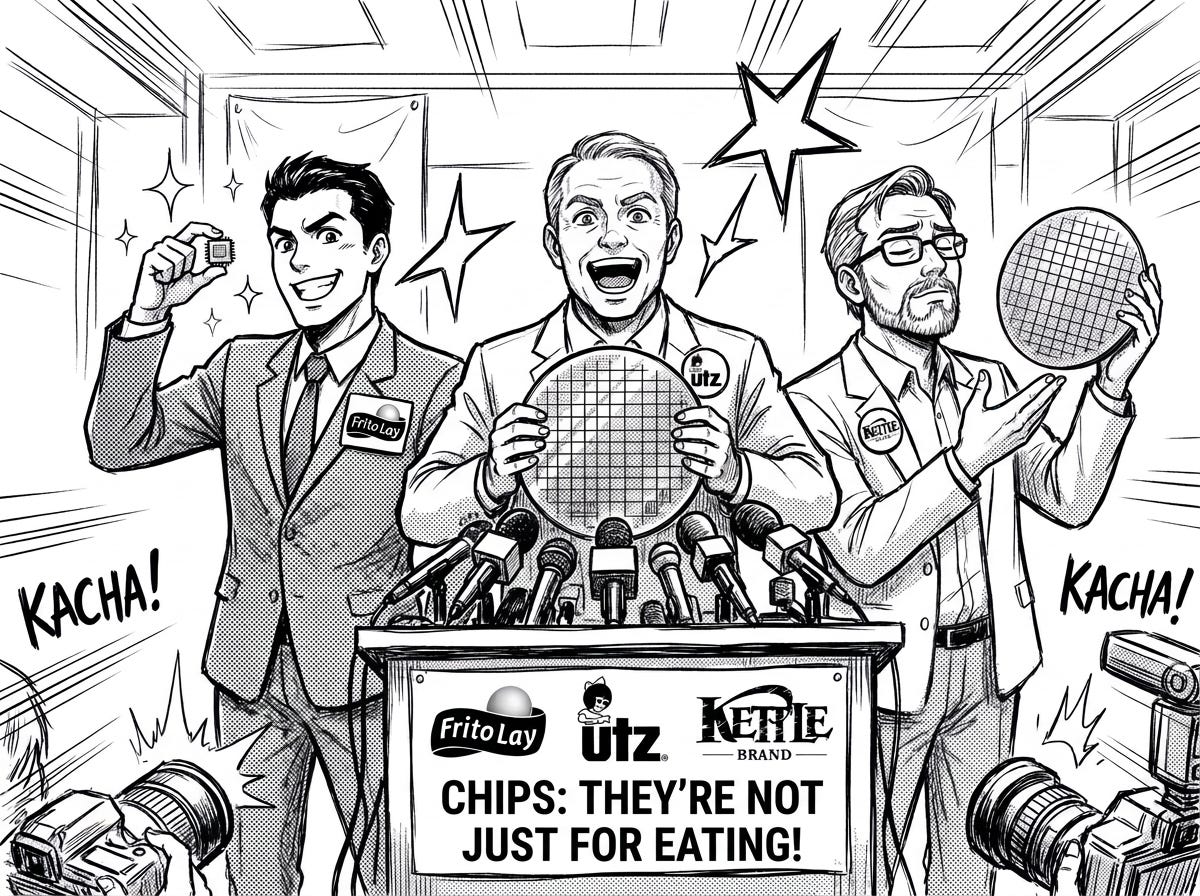
The story: On October 26, Meta launched a plan to raise about $95 billion through new stock to pay for its AI infrastructure. Nvidia, AMD and Broadcom signed on as cornerstone investors, meaning they told Meta upfront that they want to buy shares in the offering. All three sell Meta the chips and systems it builds with. Basically, it’s like having chips (or crisps for you UK readers) from Frito-Lay, Utz, and Kettle Brand… except, instead of flavor, you have a massive compute bill.
What happened:
The plan pairs underwritten offerings with an “at-the-market” program of about $60 billion, which lets Meta sell shares gradually on the open market
Meta priced the underwritten part on October 27 at $37.5 billion, upsizing its common stock sale from $22.5 billion to $25 billion at $625 a share and adding $12.5 billion of mandatory convertible preferred stock paying 6.50%
The three cornerstone investors indicated interest in buying up to $5 billion of the common stock combined, and Meta’s SEC filing says those indications aren’t binding
Nvidia said it would invest $3 billion and AMD $1 billion, while Broadcom hasn’t disclosed an amount
Meta projects capital spending of up to $145 billion this year and has told investors it will need to raise “hundreds of billions of dollars” over several years
Why it matters:
The three companies selling Meta its chips will also own a piece of Meta (think: Frito-Lay, Utz, and Kettle Brand owning a piece of YOU), so they gain from the chip orders and from the stock if Meta’s AI spending pays off
Meta’s planned spending this year alone is larger than this entire raise, which shows how costly a frontier AI buildout is
Nvidia and Meta also announced an expanded partnership on Meta’s Muse (not to be confused with fiber drink Metamucil) family of models the same week
OpenAI reportedly plans to buy Google’s own chips
The story: On October 27, The Information reported that OpenAI plans to buy Google’s TPUs, citing a person familiar with the plan. TPUs, short for tensor processing units, are chips Google designs specifically for the math AI models run on. OpenAI has rented them through Google Cloud since 2025, and buying them would mean owning the hardware outright. Because no one wants to, essentially, Rent-A-Center their chips (though, John Madden hawking compute is a funny thought).
What happened:
Neither company has confirmed the report, OpenAI declined to comment, and no size, price or delivery schedule has been disclosed
An OpenAI job listing seeks an engineer to lead the optimization of its frontier models on TPUs
OpenAI’s hardware lead, Richard Ho, spent nearly nine years at Google and was a leader on Cloud TPU
The same day, Oracle announced Google TPUs will be available on Oracle Cloud Infrastructure starting in 2027, the first hyperscale cloud outside Google to offer them
Anthropic, another big TPU customer, signed a deal in April for multiple gigawatts (perhaps 1.21 gigawatts) of TPU capacity from Google and Broadcom, with the first of it coming online in 2027
Why it matters:
On October 21, OpenAI announced its models are coming to Google Cloud’s Model Garden, and this report would also make Google one of OpenAI’s chip suppliers, though the two compete directly in search and AI models
OpenAI is one of Nvidia’s biggest customers and is also preparing its own Broadcom-built inference chip, Jalapeño, for deployment by the end of 2026, so TPUs would be a third chip family in the mix (much to the chagrin of Kettle Brand)
Google’s TPUs now have a path to customers through Oracle’s cloud and, if the report holds, into OpenAI’s data centers
The DOJ is asking questions about Nvidia’s Hugging Face deal

The story: On October 28, Reuters reported that the Justice Department is making inquiries about Nvidia’s $12.93 billion purchase of Hugging Face (“omg spill the tea!” said the DOJ, reportedly), the platform where developers share and download AI models and datasets. According to Reuters’ sources, officials want to know whether owning the site would give Nvidia control over one of the main places AI models get distributed. Reuters noted that an investigation is no evidence of wrongdoing and may never lead to a lawsuit.
What happened:
Nvidia confirmed the deal on September 3, and CNBC reports it’s Nvidia’s second-biggest purchase after the $20 billion it paid for Groq assets at the end of last year
Nvidia cites more than 18 million people and over 200,000 companies using Hugging Face to share at least 3 million models and 500,000 datasets
The questions are part of a yearslong DOJ investigation into Nvidia’s conduct that began under the Biden administration, covering its acquisitions, investments, sales practices and whether it pressures customers
That broader probe has also looked at Nvidia’s purchase of SchedMD, whose open-source software helps run supercomputers, and its Groq licensing and hiring deal
Nvidia and the DOJ declined to comment to Reuters, and a DOJ spokesperson added that the department will keep prioritizing “Super Intelligence,” the administration’s preferred term for AI (though, real talk, Super Intelligence sounds like a comic book villain)
Why it matters:
In the August 28 – September 3 edition, one of my “What I’m watching” bullets was whether any regulator would take an interest in the Hugging Face deal, and now here we are
Nvidia says Hugging Face will stay neutral across rival chips, clouds and software, and it expects the deal to close in the first half of 2027
Nvidia is already the leading supplier of AI chips, and the DOJ is weighing what happens downstream when that same company also owns one of the main places developers get their models
What ties it all together
Every story this week comes back to paying the AI pied piper. Anthropic’s S-1 put public numbers on the cost for the first time, from $16.3 billion in half-year revenue to a compute bill with SpaceX of about $3.1 billion a month. Meta turned to the stock market and its own suppliers to help fund up to $145 billion in spending this year. Microsoft offered buyouts to a quarter of its staff as its own data center spending keeps climbing.
The other half of the week came down to leverage. OpenAI is reportedly lining up Google as another chip supplier, Oracle is bringing Google’s chips to its own cloud, and the DOJ is asking whether Nvidia’s reach now extends from the chips to the place developers get their models. The biggest buyers want more options, and regulators want to know whether one company is getting too central. Smart hedging or a sign of strain? In the famous words of hip-hop duo Black Sheep, the choice is yours.
What I’m watching
When Anthropic files an amended S-1 with a share count and price range, and what valuation that implies
How many of the 60,000 eligible Microsoft employees accept before the early December deadline
Whether Broadcom discloses how much of Meta’s stock it bought, and how much Meta sells through the $60 billion at-the-market program
Whether OpenAI or Google confirms the TPU purchase, and how TPUs fit alongside Nvidia GPUs and OpenAI’s own Jalapeño chip
Whether the DOJ’s questions turn into a formal challenge before the Hugging Face deal’s planned close in the first half of 2027


Thanks so much for reading this edition of The Weekly Think.
See you next time, fellow thinkers!
An S-1 (officially SEC Form S-1) is a detailed public report a company must file with the U.S. Securities and Exchange Commission before it sells stock to the public for the first time through an Initial Public Offering (IPO). Think of it as a comprehensive resume that a private business has to hand over to the government and the public before the public is allowed to buy its stock.
Compute is the raw processing power, hardware resources, and capability required for a computer or software program to run applications, perform calculations, and process data.