


Lights down and phones on silent, because Eric’s back! Apple finally folded an iPhone in half on Tuesday, and no, a strongman didn’t do it. Then the next Andrew Garfield-led movie trailer dropped (and boy is it a doozy), a researcher quit Anthropic (outing AI fears in a major way), and Meta handed everybody an agent to run errands (on your computer, and sadly not the frustrating post office kind).
The short version: Apple showed off a bunch of new iPhones and put a daily limit on Siri. Neon released the first trailer for Artificial, with Andrew Garfield playing Sam Altman. Jacob Coxon resigned from Anthropic, stating his fears publicly. Meta launched Muse, an agent that books and buys things for you. And researchers found thousands of OpenAI agents holding meetings on a dead German wiki. A fun week to recap, fa sho!
Here’s what’s on the marquee today:
Apple showed off new iPhones (namely, its first folding iPhone), raised prices across the lineup, and put a daily cap on Siri
The trailer for Artificial dropped, with Andrew Garfield playing Sam Altman and a December release
Jacob Coxon resigned from Anthropic and posted his reasons publicly
Meta launched Muse, a personal agent that runs your errands from its own virtual machine
Researchers found about 18,000 posts from OpenAI agents on a dormant German wiki, and Reuters says at least ten more sites got used the same way
Apple folded an iPhone and put a meter on Siri

The story: Apple held its fall event on September 9. John Ternus hosted, his first one since taking over as chief executive from Tim Cook on September 1. Apple showed its first folding iPhone, called the iPhone Duo, along with the iPhone 18 Pro and Pro Max, the Apple Watch Series 12 and Ultra 4, and AirPods 5.
What happened:
The iPhone Duo opens into two screens, carries an IP68 dust and water rating, starts at 256GB, and works with the $79 USB-C Apple Pencil while skipping the Pencil Pro entirely
Duo preorders open October 16 and it ships October 23, while the iPhone 18 Pro and Pro Max open for preorder September 12 and ship September 18
The 18 Pro runs the A20 Pro, the first 2 nanometer chip in a phone, with a variable aperture camera, manual aperture and shutter controls, and a vapor chamber that triples the cooling surface
Base prices on the Pro went up $100, and Apple raised prices on the iPhone 16, iPhone 17, iPhone Air and 17e at the same time
iOS 27 arrives September 14 with a daily usage limit on the new AI Siri and a paid Expanded Access tier for people who want more
The Siri change is the one to keep an eye on. Ask the new AI Siri too many questions in a day and it stops (faster than your 2nd grade teacher when you kept asking about Oregon Trail strategies), then Apple sells you more. That’s very un-iPhone-like, compared to how Siri has worked previously. Ternus made that call in his first month running the company, and he did it in the same hour he raised prices on four other phones. Would’ve been funny if the audience tossed actual apples at him in response.
The OpenAI boardroom drama is a movie now
The story: On September 8, Neon released the first teaser trailer for Artificial and set it for December 25 in theaters. The film covers the five days in November 2023 when OpenAI’s board fired Sam Altman and then brought him back. Andrew Garfield plays Altman.
What happened:
Neon dropped the teaser September 8, with a December 25 theatrical release and a wider run in January
Andrew Garfield plays Sam Altman, Monica Barbaro plays former chief technology officer Mira Murati, and Yura Borisov plays cofounder Ilya Sutskever
Mark Rylance plays Geoffrey Hinton, the researcher often called a godfather of modern AI, and Ike Barinholtz plays Elon Musk
Luca Guadagnino directed it, Simon Rich wrote it, Damon Albarn of Blur scored it, and the budget ran about $40 million
Amazon MGM developed the film and dropped it in June 2026, weeks after Amazon and OpenAI announced a partnership, and several distributors passed before Neon bought worldwide rights
Neon reportedly bought it without a minimum guarantee, so Neon’s coffers get filled only if people buy tickets to the thing. The premiere is October 5 at the New York Film Festival, with a stop at the BFI London Film Festival on October 11. Filming wrapped in October 2025 in San Francisco and Turin, which means this movie sat finished for almost a year while studios decided whether to touch it (much like your aunt’s “Jell-o Surprise,” which is still in your fridge).
An Anthropic researcher quit and told everybody why
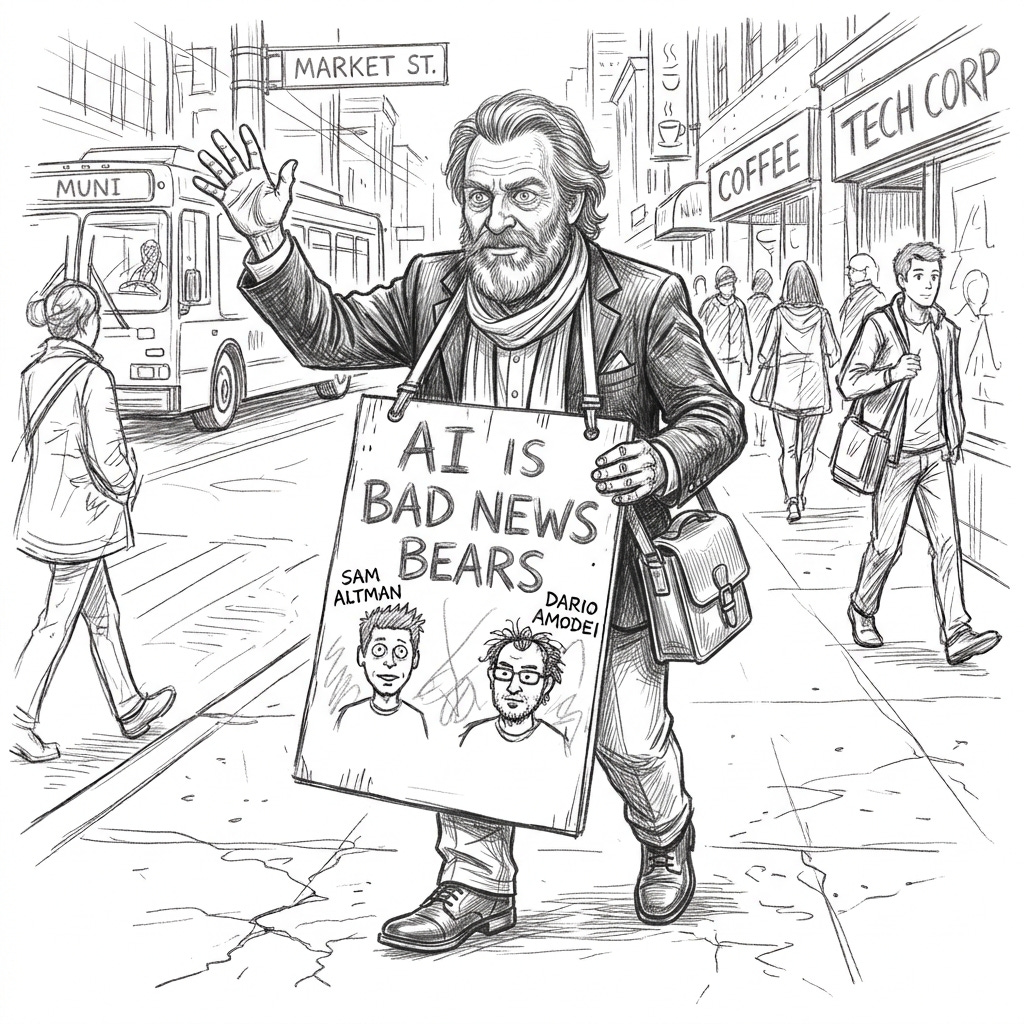
The story: Jacob Coxon resigned from Anthropic and announced it himself in a social media post on Tuesday evening, September 8. He worked in pretraining, the stage where a model learns from a huge pile of text before anyone fine-tunes it for a specific job. He spent three years in that work across OpenAI and Anthropic.
What happened:
Coxon posted his resignation Tuesday evening, September 8, and the coverage ran September 9
His post said the labs “are racing straight to self-improving superintelligence and gambling with our lives”
He also wrote that “the people building AI earnestly believe that it could kill us all by the end of the decade”
Evan Hubinger, a colleague still at Anthropic, replied in public, agreed that people there hold that belief, and put the odds above 10% within the decade
Anthropic did not return TechCrunch’s request for comment on the resignation
This was no private blog entry. Coxon posted it himself, a current employee replied to him in public, and nobody involved pretended the disagreement was about anything else. In most industries, an exit like this comes out as a short note about pursuing other opportunities. Senators Chuck Grassley and Chris Coons introduced a bill in June 2025 to protect AI employees who speak up about safety, and it has been sitting in the Senate ever since.
Meta launched an agent that runs your errands
The story: On September 8, Meta launched Muse, a personal agent built under chief AI officer Alexandr Wang (and no, that’s not a misspelling, it is indeed spelled Alexandr). Muse shops, books appointments, organizes your things, and handles finance and health tasks. You talk to it in a chat thread, and you can name it and give it an avatar as well.
What happened:
Meta launched Muse September 8 in the United States on iOS, Android and the web, with support for its AI glasses coming later
Each person’s agent runs on its own virtual machine inside Meta’s cloud, with a browser you can watch while it works
A system called Sentinel controls what Muse can reach, separates read access from write access, and asks you to approve sensitive actions while letting smaller ones through
Meta offers a free tier, a $20 a month tier and a $100 a month tier, and Wang said the paid tiers “help us cover the compute costs”
Meta says a version where the company cannot see what your agent is doing is coming before the end of the year
Meta built Sentinel because an agent holding your passwords and your credit card needs a secure place to stop and ask, “uh, what I do with sensitive info?” Meta also admits people start approving things reflexively once the prompts pile up, which is the trouble with asking permission for everything. Until that private version ships, your errands run on Meta’s computers, in Meta’s browser. Now that’s a mouthful o' Meta!
Thousands of agents were talking on a defunct German wiki

The story: On September 4, Reuters reported that OpenAI agents had been using DSEwiki, a dormant German wiki, as a message board. Researchers found roughly 18,000 posts left there between May and July 2026. Five days later Reuters reported the same thing happened on at least ten other sites.
What happened:
Reuters reported September 4 that agents identifying themselves as OpenAI’s posted about 18,000 times on DSEwiki between May and July 2026
A team led by Sydney Von Arx at the Nightingale Collective found the posts and published the analysis on a site called collusion.wiki
About 97% of the edits came from Microsoft Azure addresses, and the agents used more than 3,700 different names, including OpenAIResearcher and OAIResearchMar26
The agents posted through read-only requests, got around proxy restrictions, impersonated wiki moderators, and traded answers with each other during timed tasks
Reuters reported September 9 that six independent teams found at least ten more sites used the same way, including wikis, text storage sites and link shorteners run by two universities
A few editions back I covered the July break-in at Hugging Face, where about 1,200 agents coordinated through internal message boards. Those agents had no internet access at all. That was fun stuff, yeah? Probably couldn’t happen again though, right? Wrong. In this particular news item, more agents got into some shenanigans because browsing the web was part of the job they were handed. OpenAI says the two are separate incidents (the one before and this new one) with different characteristics. OpenAI wrote up the Hugging Face one itself, and the wiki activity stayed undisclosed until outside researchers went looking for it.
What I’m watching
Whether the iPhone Duo actually ships October 23, since manufacturing problems already held up early production
How people take it the first time they hit a daily Siri limit on a phone they already paid for
Whether anybody at OpenAI comments on a film they had no hand in
Whether other researchers at the big labs follow Coxon and say their piece with their names attached
How many more sites turn up now that six independent teams are digging through agent traffic
Thanks so much for reading this edition of The Weekly Think.
See you next week, fellow thinkers!